
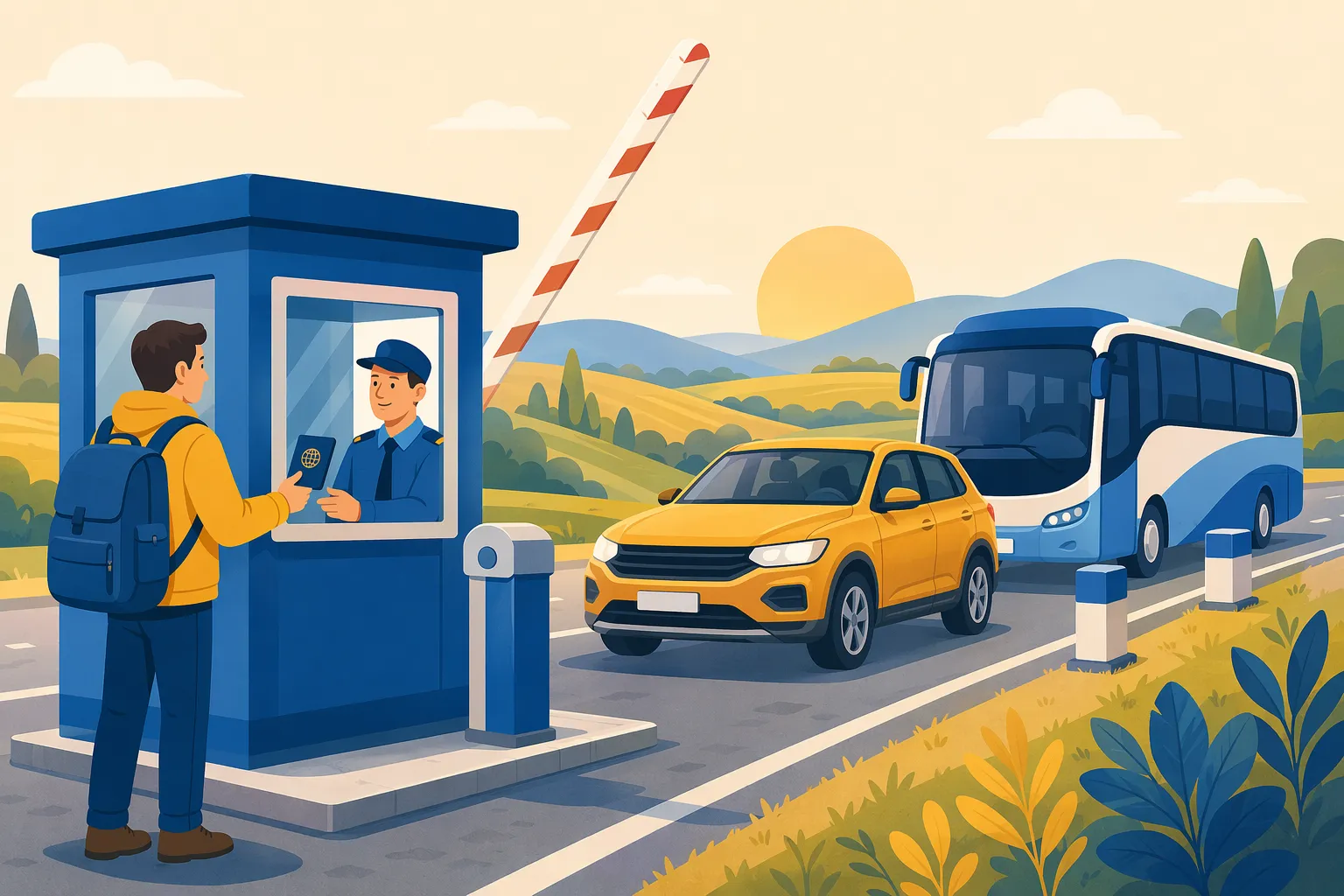
How to Cross the Ukrainian Border in 2026: A Step-by-Step Guide for Foreigners
There is no arrivals hall waiting for you in Kyiv. In 2026, Ukrainian airspace remains closed to civilian aviation under martial law, so every foreign visitor — journalist, aid worker, business traveler, or someone going to see family — enters the same way: by land, through Poland, Hungary, Slovakia, Romania, or Moldova. The border regime that greets you is orderly but noticeably more thorough than a typical Schengen crossing.
First-time travelers often focus on the queue, but document checks can also affect processing time. Carry your passport, proof of funds, accommodation details, and valid medical insurance. Requirements and checks can vary by nationality, visa status, and current rules, so verify official guidance before travel.
This guide covers entry considerations for 2026, the typical stages of a crossing, questions officers may ask, common routes from Poland and Hungary — Medyka–Shehyni and Záhony–Chop among them — and documents worth preparing in advance.
Quick Answer
💡 Foreign visitors currently enter Ukraine by land because airspace is closed to civilian flights. Many visa-free nationals, including citizens of the EU, UK, US, and Canada, may stay for up to 90 days in any 180-day period. Entry conditions vary by nationality, visa status, travel purpose, and current rules; verify official Ukrainian guidance and carry a valid passport, supporting documents, and prudent medical coverage for the full stay. Border processing times vary substantially by route, traffic, and current conditions.
Key Takeaways
- Entry is by land only — through Poland, Hungary, Slovakia, Romania, or Moldova. Airports are closed.
- Visa-free stays are capped at 90 days within any rolling 180-day period. Past trips count.
- Insurance requirements and checks can vary by nationality, visa status, and current rules; carry valid medical cover for the whole stay and be ready to show it.
- Every crossing has six stages: EU exit control, neutral zone, Ukrainian passport control, customs, security screening, release.
- Cash of €10,000 or more must be declared in writing.
- Scheduled rail via Przemyśl can reduce exposure to road queues, but timetables and border processing can still change.
Ukraine Entry Requirements in 2026: What Foreign Travelers Should Prepare
Ukraine remains open to many foreign visitors, subject to nationality, visa status, travel purpose, and current restrictions. Rules and their application can change during martial law — our full overview of Ukraine's entry requirements in 2026 covers additional detail, while the practical essentials are below.
Visa-free entry. Citizens of the European Union, the United Kingdom, the United States, Canada, and a number of other countries can enter Ukraine without a visa for up to 90 days within any 180-day period. The rule is rolling: days from previous trips count until they fall outside the 180-day window — see how the 90/180 visa-free rule is calculated if you have crossed recently. Travelers from countries without a visa-free agreement must obtain a visa or e-Visa before arriving at the border.
A valid passport. It should be undamaged, machine-readable, and valid for your entire stay — ideally with several months of validity beyond your planned departure. Biometric passports speed up processing.
Medical insurance. Requirements and border checks may vary by nationality, visa status, travel purpose, and current rules. Verify official Ukrainian guidance before departure. Carrying valid medical coverage for the full stay is prudent and may be requested; keep the policy PDF available offline and carry a printed copy as a practical backup.
Supporting documents. Officers may request proof of sufficient funds (cash, bank cards, or statements), accommodation details, a return or onward ticket, and an explanation of your travel purpose. There is no single published minimum amount of funds, so carry clear evidence that you can support yourself — the complete list of documents required to enter Ukraine in 2026 is worth reviewing before you pack.
The 6 Stages of Every Ukrainian Border Crossing
Land crossings into Ukraine generally follow a similar sequence, although the order and intensity of checks can vary by checkpoint, transport mode, and current conditions. Knowing the typical stages in advance can make the process easier to navigate.
- Exit control on the EU side. You first clear passport control of the country you are leaving — Polish Border Guard at Medyka, Hungarian police at Záhony. Schengen exit stamps are recorded; EU customs may inspect vehicles.
- The neutral zone. A short stretch of road or a bridge separates the two checkpoints. Vehicles queue here; pedestrians walk a fenced corridor. Photography is prohibited here at essentially all crossings.
- Ukrainian passport control. An officer of the State Border Guard Service of Ukraine scans your passport and checks it against databases. This is where questions are asked, insurance and funds may be checked, and your entry stamp is placed. Some crossings also take a photo.
- Customs inspection. The State Customs Service handles this stage. Most travelers with personal luggage pass through a green channel with nothing more than a glance; a red channel exists for goods that must be declared. Cash of €10,000 or more (or equivalent) must be declared in writing. Vehicles are inspected more thoroughly — expect the trunk opened, occasionally a full scan.
- Security screening. During martial law, luggage may be X-rayed, and questions about drones, body armor, optics, or other dual-use equipment are routine. Such items are not automatically forbidden, but they must be declared and may require documentation.
- Release into Ukraine. Once stamped and cleared, you are through. Major crossings have currency exchange, SIM card sellers, taxis, and buses onward to Lviv, Uzhhorod, or Kyiv.
Processing time can range widely and may change without notice. Traffic, transport mode, staffing, security procedures, and document questions can all affect the wait.
Questions Border Officers Actually Ask — and How to Answer Them
First-time visitors are often surprised less by the documents than by the conversation. Officers are expected to understand who is entering the country and why, so a short interview is normal — not a sign of trouble.
Typical questions include:
- What is the purpose of your visit? Tourism, family visit, business, volunteering, journalism. Give a direct, truthful answer. Vague answers invite follow-ups.
- Where will you stay? Have a hotel booking, rental confirmation, or your host's address and phone number ready.
- How long are you staying, and how will you leave? A return bus ticket or onward itinerary answers this instantly.
- Do you have medical insurance? Be ready to show the policy PDF and point to the coverage dates.
- How much money are you carrying? This is both a proof-of-funds question and a customs question.
- Have you been to Ukraine before? Officers can see your entry history; answer consistently with your stamps.
Journalists planning to work should verify current accreditation requirements with the relevant Ukrainian authorities; volunteers may benefit from an invitation letter from the receiving organization. Search procedures, luggage checks, interview length, and language availability vary by checkpoint and circumstances, so allow time and follow officers' instructions.
Best Border Crossings Into Ukraine: Poland, Hungary, and Beyond
With airports closed, established land routes run through Poland, Hungary, Slovakia, Romania, and Moldova. From Western Europe, Poland and Hungary are common corridors.
From Poland
Poland is a common gateway, with rail and bus links from Warsaw and Kraków — our guide to entering Ukraine from Poland covers route and insurance considerations in depth.
- Medyka–Shehyni is a well-known pedestrian crossing, a short taxi or bus ride from Przemyśl, with onward connections toward Lviv. Confirm current operating status and allow flexible time because queues and permitted traffic can change.
- Korczowa–Krakovets is the main motorway crossing on the Warsaw–Lviv axis, preferred by buses and private cars.
- Dorohusk–Yahodyn serves traffic from Lublin toward Kovel and northern Ukraine, and carries heavy freight.
- Rail via Przemyśl. The most comfortable option: direct Ukrzaliznytsia trains run from Przemyśl Główny to Lviv and Kyiv, with passport control at the station and on board while you sit.
From Hungary
For those traveling to Ukraine via Hungary, two crossings do most of the work:
- Záhony–Chop is Hungary's principal crossing, linking the Hungarian rail network with Zakarpattia. Trains and vehicles cross here, and Chop station connects onward to Uzhhorod, Lviv, and Kyiv.
- Beregsurány–Luzhanka is a quieter road crossing convenient for Berehove and the Transcarpathian lowlands.
Other routes
Other established routes include Slovakia's Vyšné Nemecké–Uzhhorod, Romania's Siret–Porubne north of Suceava toward Chernivtsi, and Moldova's Palanca crossing toward Odesa. Operations and permitted traffic categories can change, so confirm the checkpoint's current status and official queue information before departure.
Drivers, note: car insurance is separate from medical insurance. Vehicles entering Ukraine need a Green Card or Ukrainian frontier motor policy, checked independently of your personal medical cover.
Staying Safe After the Border: Curfews, Air Alerts, and Checkpoints
The western regions of Zakarpattia, Lviv, and Volyn are farther from the front line, and many daily services continue, but missile and drone attacks and other wartime disruptions remain possible. Martial law shapes travel from the moment you cross.
- Curfew. Most regions enforce a nighttime curfew, typically from around midnight to 5 a.m. Plan onward travel so you are not on the road during those hours.
- Air raid alerts. Sirens can sound anywhere. Download an alert app (such as Air Alert / Povitryana Tryvoha), follow official instructions, and go to shelter; never assume an alert will be uneventful.
- Checkpoints inside the country. Expect occasional document checks on highways. Carry your passport at all times — it is a legal requirement.
- Restricted zones. Areas near active hostilities and certain border strips are closed to visitors. Do not improvise routes east without current information.
- Follow official advisories. Your government's travel advisory and updates from Ukrainian authorities are the baseline for route planning.
None of this makes travel impossible — it makes preparation and situational awareness part of the trip.
Medical Insurance: A Document to Prepare Before Travel
Insurance is an important part of travel preparation. Entry requirements and checks vary by nationality, visa status, and current rules, while EHIC/GHIC arrangements do not apply in Ukraine and many standard travel policies exclude Ukraine, travel against official advice, or war-related claims. Confirm the territory, advice-related exclusions, and covered events in writing with the insurer before relying on any policy.
A policy prepared for travel should cover the entire stay, clearly name Ukraine as covered territory, and provide accessible proof of cover. The EUROINS product offered through Insurance Ukraine describes eligible treatment for certain war-related injuries and an optional radiation-risk extension, subject to the policy wording, insured limits, exclusions, eligibility rules, and the circumstances of the covered event; coverage and payment are not guaranteed for every incident. The Basic tier has an insured amount of 100,000 UAH (about €2,000), while Advanced has €30,000. Pricing starts from €3.56 for a three-day Basic policy and €5.75 for Advanced, with each additional day adding €1.08 or €1.73 respectively; policies run from 3 to 180 days, payment is processed online through WayForPay and charged in hryvnia, and travelers must be under 70. The optional radiation-risk add-on costs 3.5 times the base price. Always read the current policy terms before purchase.
Buy the policy before you travel — the queue at Shehyni on patchy mobile data is not the moment for it.
👉 Get covered today
Buy InsuranceYour Pre-Crossing Checklist: 12 Things to Confirm the Day Before
- Passport valid well beyond your departure date, undamaged
- Days counted against the 90/180 visa-free limit (include past trips)
- Visa or e-Visa obtained, if your nationality requires one
- Medical insurance covering every day of the stay — PDF saved offline, plus a printed copy
- Accommodation confirmation or host's address and phone number
- Return or onward ticket
- Proof of funds: cards plus some cash in euros or zloty/forint; under €10,000 or declared
- Green Card motor insurance, if driving
- Accreditation or invitation letters, if traveling for journalism or volunteering
- Air-alert app downloaded; curfew hours checked for your destination
- Queue status checked for your chosen crossing
- Small amounts of hryvnia or an exchange plan for the Ukrainian side
Related insurance and country guides
Use these related pages to compare policy types, country-specific requirements, and current entry rules for Ukraine.
More Ukraine travel insurance guides
Continue with practical guides that update automatically as new blog articles are published.