
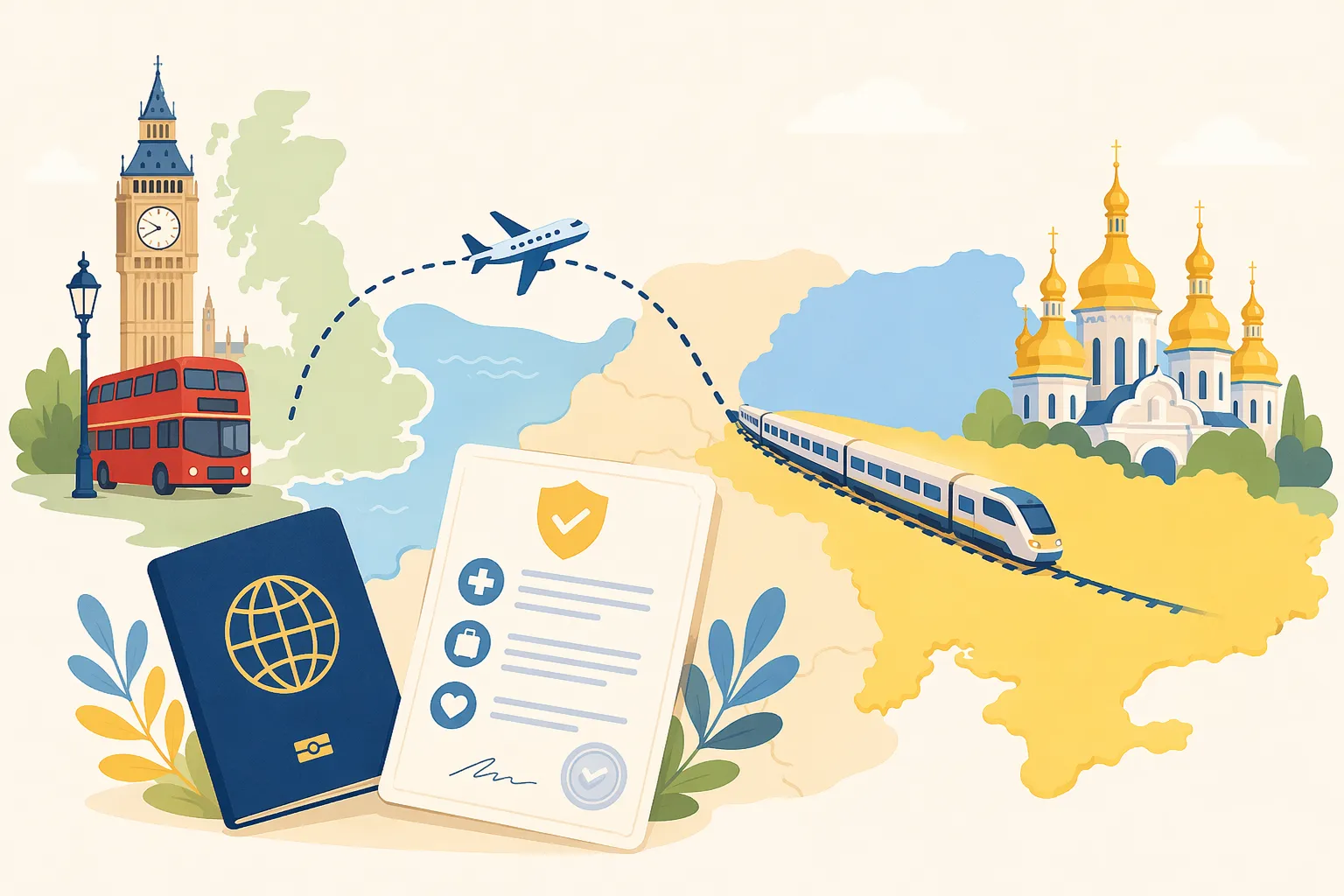
UK to Ukraine in 2026: Entry Rules, Safer Route Planning, and Insurance Limits
You cannot currently fly direct from London to Kyiv. A bank or annual policy may exclude Ukraine, travel against FCDO advice, or war-related claims, so confirm written terms before relying on it. British aid workers, volunteers, journalists, business travelers, and people visiting family who travel must prepare for an overland route and wartime risk.
Preparation matters. Common routes run through Poland, and UK citizens can generally use Ukraine's visa-free regime for short stays. Carry valid medical cover for Ukraine and review current entry rules. The FCDO advisory does not itself void a policy; many insurers instead use policy terms that exclude travel against advice, Ukraine, or war-related claims.
This guide covers post-Brexit entry rules, overland routes while Ukrainian airspace stays closed, safety habits under martial law, insurance questions, and a pre-departure checklist. This is not a trip to improvise: read current FCDO and Ukrainian guidance, assess personal risk, and keep plans flexible.
Quick Answer
💡 UK citizens can generally use Ukraine's visa-free regime for short stays, commonly up to 90 days in a 180-day period, but entry requirements depend on nationality, visa status, purpose, and current rules. Verify official Ukrainian guidance before travel. There are no direct civilian flights, so travelers commonly fly to Poland and continue by land via Przemyśl. Carry medical cover valid in Ukraine for the whole stay and confirm any FCDO-advice or war-related exclusions in writing.
Key Takeaways
- UK passport holders can generally use visa-free entry for short stays, commonly up to 90 days in a rolling 180-day period; verify current official rules for your circumstances.
- No civilian flights operate to Ukraine. Fly to Poland and continue by train via Przemyśl.
- Verify current insurance requirements and carry medical cover valid in Ukraine for the entire stay.
- Many UK policies exclude Ukraine, travel against FCDO advice, or war-related claims; the advisory itself does not void cover.
- GHIC and EHIC arrangements do not apply in Ukraine.
- The EUROINS product starts from €3.56 and describes specified war-related cover subject to its terms.
- Curfews, air-raid alerts, and checkpoint document checks are part of daily life — plan for them.
Do UK Citizens Need a Visa for Ukraine? What Brexit Did and Didn't Change
Brexit did not itself replace Ukraine's separate entry arrangements for UK citizens. UK passport holders can generally enter without a visa for short stays, but requirements vary by nationality, visa status, purpose, and current rules. Verify current official Ukrainian guidance before travel.
For an eligible short visit, the commonly stated limit is up to 90 days in Ukraine within a rolling 180-day period, not a fixed calendar period. If you make multiple trips, count every day spent in the country and verify how the current rule applies to your nationality, visa status, and purpose. Overstaying can lead to penalties or future entry problems.
What you need at the border:
- A valid passport. It should be valid for the entire duration of your stay. The post-Brexit blue passport is accepted exactly as the old burgundy one was.
- Medical insurance covering your whole stay. Requirements and checks vary by nationality, visa status, and current rules. Verify official guidance, carry cover valid in Ukraine, and keep the policy accessible.
- Proof of sufficient funds. There is no single published figure; bank cards, cash, or a recent statement are all acceptable.
- Supporting documents on request. Accommodation confirmation, a return or onward ticket, and a rough itinerary can all be requested. Having them ready keeps the crossing short — the full list of documents required to enter Ukraine is worth a read before you pack.
Long stays, work, volunteering, study, residence, or other purposes may require a visa, permit, or supporting documents. Check the current route for your circumstances with official Ukrainian authorities or the relevant consulate before travel.
How to Get from the UK to Ukraine in 2026: The Routes That Actually Work
Ukrainian airspace has been closed to civilian aviation since February 2022, so there are no direct flights from London, Manchester, or anywhere else. A typical journey from the UK involves flying to a neighboring country and continuing overland. Established routes run through Poland, Hungary, Slovakia, Romania, and Moldova, subject to current checkpoint operations; Poland is often the most practical corridor from Britain.
The standard route looks like this:
- Fly from the UK to Poland. Kraków, Warsaw, and especially Rzeszów are the usual gateways; Rzeszów-Jasionka airport sits roughly 90 kilometres from the border and is the informal hub for Ukraine-bound travel.
- Reach the border region. Trains and buses connect all three cities to Przemyśl, the Polish railway town closest to the main crossings.
- Cross into Ukraine. Most UK travelers take the direct train from Przemyśl to Lviv and on to Kyiv, because passport control happens on board or at the station rather than in a queue of cars. Ukrzaliznytsia, the national railway, runs these services daily. Road crossings such as Medyka–Shehyni and Korczowa–Krakovets serve buses and cars.
- Continue onward. Lviv is about an hour from the border; Kyiv is an overnight journey of roughly 9–11 hours.
Hungary's crossing at Záhony–Chop and Romania's Siret–Porubne route toward Chernivtsi both work, but connections from UK airports are thinner, which is why the Polish corridor dominates.
Budget realistic time. Border waits fluctuate — rail is usually predictable, road crossings less so. Planning your first night in Lviv rather than pushing straight to Kyiv removes most of the schedule risk.
Before You Leave the UK: Documents, Money, Phone, and Health
A trip to Ukraine rewards the kind of preparation you might skip for a weekend in Spain.
Documents. Carry your passport plus printed and digital copies of everything: insurance policy, accommodation bookings, tickets, and emergency contacts. A paper backup costs nothing and survives a dead phone battery.
Money. The Ukrainian hryvnia (UAH) is the only legal tender. Visa and Mastercard work almost everywhere in major cities and ATMs are plentiful, but carry some cash for smaller towns and the border journey. Tell your bank you are traveling; a card frozen for "suspicious activity in Ukraine" is a solvable but tedious problem.
Phone and connectivity. UK roaming packages for Ukraine can be expensive. A local SIM or eSIM from Kyivstar, Vodafone Ukraine, or lifecell is cheap and gives you reliable data — and air-raid alert apps depend on it.
Health. Bring prescription medication in its original packaging with a copy of the prescription. The UK Global Health Insurance Card (GHIC) and the old EHIC do not cover Ukraine — they are EU instruments, and Ukraine sits outside the scheme.
Apps. The official air-raid alert app (Air Alert), offline maps, and your embassy's contact details — all installed before departure.
Staying Safe Under Martial Law: Curfews, Alerts, and Checkpoints
Many services continue under martial law, but attacks, alerts, curfews, transport disruption, and outages remain possible. Visitors must respect current restrictions and should review official travel advice before deciding to go.
Curfews. Curfew rules and hours vary by oblast and can change at short notice. Check local official notices, follow any authorization requirements, and do not assume transport will operate near curfew hours.
Air-raid alerts. Sirens and app notifications signal alerts. Follow the official guidance: move to a shelter, a metro station, or at minimum an interior corridor away from windows. Hotels will point you to their shelter on check-in — ask if they don't.
Regional differences. Risk levels and restrictions change, and no region is free from attack risk. Western regions are generally farther from active front lines, while Kyiv also experiences attacks. Do not enter prohibited or active-hostility areas; check current official advice and local restrictions for every destination.
Documents and checkpoints. Carry your passport at all times. Military and police checkpoints are routine; checks are usually brief and courteous when paperwork is in order. Photographing military personnel, checkpoints, infrastructure, or air-defence activity is illegal — this is enforced, and it is the easiest way for a well-meaning visitor to create a serious problem.
Emergency number. Dial 112 — it works nationwide for police, fire, and ambulance.
The FCDO Issue: Why Standard UK Cover May Not Apply in Ukraine
This issue is easy to overlook unless the insurer's written terms are checked before departure.
Many standard UK policies contain exclusions for destinations where the FCDO advises against all or all but essential travel, for Ukraine as a territory, and/or for war-related claims. The FCDO advisory does not itself void insurance: the policy wording controls. Ask the insurer to confirm in writing whether Ukraine, travel against advice, planned activities, and relevant events are covered.
Travelers should distinguish proof of insurance from the scope of cover. Entry requirements vary, and a policy shown at the border may still contain exclusions affecting a later claim. Compare territory, dates, insured limits, advice-related exclusions, war clauses, eligibility, and assistance procedures before purchase.
What Ukraine-Specific Insurance Covers — and What It Actually Costs
Beyond entry-document questions, consider medical costs. GHIC arrangements do not apply in Ukraine, and a foreign visitor may be billed for private or public treatment. Whether an insurer pays depends on policy terms, limits, exclusions, eligibility, approvals, and the covered event.
The EUROINS product is purchased online and issued as a digital PDF after successful payment. Its wording describes eligible treatment for certain war-related injuries and an optional radiation-risk extension, subject to insured limits, exclusions, eligibility, assistance procedures, and the circumstances of the covered event; no claim outcome is guaranteed. Basic has an insured amount of 100,000 UAH (about €2,000), while Advanced has €30,000. Prices start at €3.56 for a three-day Basic policy or €5.75 for Advanced, with each extra day costing €1.08 or €1.73 respectively; policies run from 3 to 180 days, payment is charged in hryvnia, and travelers must be under 70. Read the current policy terms before purchase.
Insurance does not make Ukraine safe. It may reimburse eligible costs within the insured amount, subject to policy wording, limits, exclusions, eligibility, approvals, and the covered event; travelers can still face uninsured expenses.
👉 Get covered today
Buy InsuranceYour UK-to-Ukraine Pre-Departure Checklist
Work through this in order, starting two to three weeks out:
- Check your passport — valid for your entire stay, with a spare photo page.
- Read current FCDO advice and ask your insurer to confirm in writing how advice-related and war exclusions affect your cover.
- Arrange medical insurance confirmed valid in Ukraine for every travel day; save the PDF and print a copy.
- Book flights to Poland — Rzeszów, Kraków, or Warsaw — and the onward connection to Przemyśl.
- Reserve the Przemyśl–Lviv or Przemyśl–Kyiv train through Ukrzaliznytsia; seats sell out.
- Book your first night's accommodation and keep the confirmation offline.
- Prepare proof of funds — a bank statement or card you can show if asked.
- Arrange a return or onward ticket, even a flexible one.
- Install the air-raid alert app, offline maps, and save 112 plus the British Embassy Kyiv contacts.
- Sort money — notify your bank, carry some cash to exchange into hryvnia.
- Pack medication in original packaging with prescription copies.
- Tell someone your itinerary and set a check-in routine.
- Count your 90/180 days if you have visited Ukraine in the past six months.
Related insurance and country guides
Use these related pages to compare policy types, country-specific requirements, and current entry rules for Ukraine.
More Ukraine travel insurance guides
Continue with practical guides that update automatically as new blog articles are published.